You know when your thoughts feel like they’re scattering in a hundred different directions at once?
That’s pretty much my daily reality with ADHD.
I was trying to explain this to my friend over coffee last week. How sometimes my brain feels like it’s speaking an entirely different language than the rest of me. She nodded politely, but I could tell she didn’t quite get it. I mean, how do you explain what it’s like when your own thoughts won’t stay put long enough to catch them?
That’s when I pulled out my phone and showed her my color-coded calendar. “This,” I said, “is the translator between my brain and the world.”
The Messy Reality Behind My Screen
Living with ADHD means I’ve tried just about every organizational system out there. Most of them failed spectacularly within days (sometimes hours) of starting them. It wasn’t until I leaned into visual systems—ones that actually work with how my brain processes information instead of fighting against it—that things began to click.
I used to think I was just disorganized. Lazy, even. But turns out my brain just needs to see things differently. Text-heavy planners? Useless to me. But give me colors, shapes, and visual cues? Now we’re talking.
Seven Things That Actually Work For Me
After years of trial and error (mostly error, if I’m being honest), I’ve found seven approaches that help translate my scattered thoughts into something I can actually work with:
1. Color-Coding (My Lifeline)
I color-code literally everything. Red for urgent stuff that needs immediate attention. Blue for work projects. Green for personal goals. Yellow for things related to my kids.
It sounds simple, but seeing those colors instantly triggers my brain to switch contexts. On overwhelmed days, I can just look for the red items and ignore everything else without feeling guilty.
2. Labels That Actually Make Sense
I used to try labeling things the way I thought I “should”—by date or alphabetically or whatever system normal people use. Then I realized I could just… label things the way my brain naturally categorizes them?
So now I have folders labeled things like “Stuff I’ll probably need when I’m panicking about taxes” and “Ideas that seemed brilliant at 3am.” It works because it matches how I actually think.
3. Visual Schedules That Don’t Make Me Want to Cry
Traditional planners make me want to throw them out the window. All those lines and tiny spaces… no thanks.
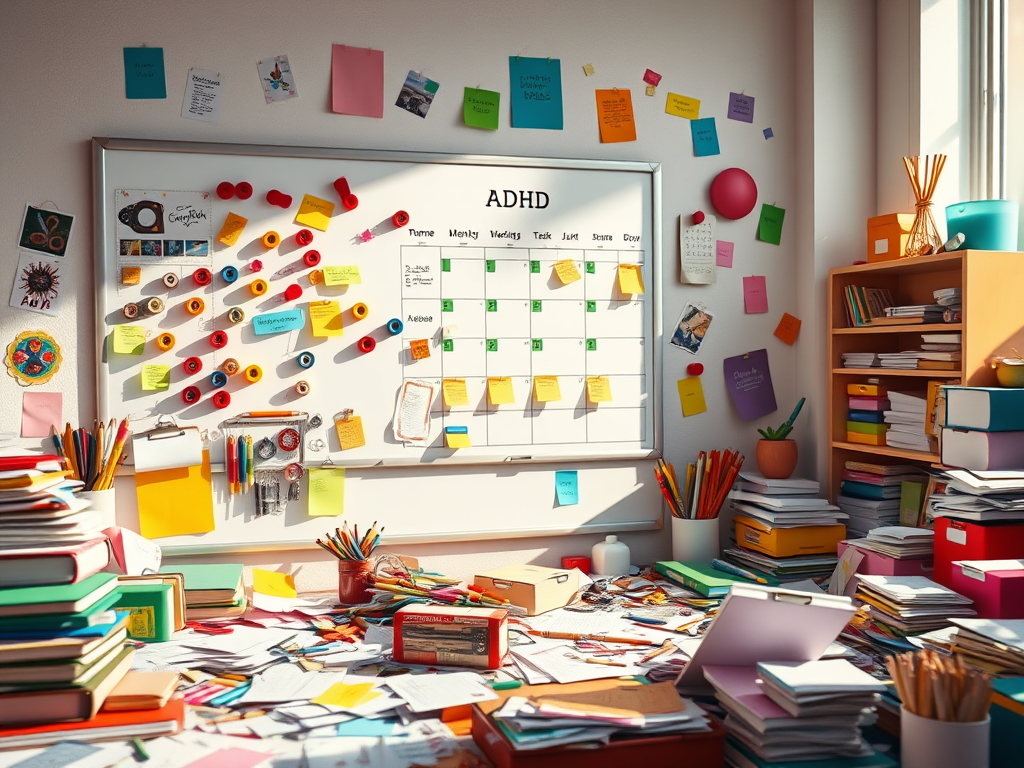
Instead, I use a giant whiteboard with colorful magnets that I can physically move around. There’s something about that tactile experience that helps ideas stick in my brain better. When plans change (which they always do), I just move the magnets around rather than feeling bad about “messing up” my perfect planner.
4. Workspace Zones That Keep Me On Track
I’ve learned that I need different spaces for different types of thinking. My desk has an actual taped-off section for focused work, another area for creative stuff, and a third spot that’s just for organizing papers.
Switching physical locations, even by just a few feet, helps my brain understand we’re shifting gears. It’s weird but it works.
5. Digital Tools That Don’t Overwhelm Me
After trying about fifty different productivity apps, I’ve settled on just a couple that work with my visual brain:
Trello has become my external brain. Those movable cards just make sense to me—I can literally see my tasks moving from “thinking about it” to “actually doing it” to “done!”
Google Calendar with different colored blocks helps me visualize time in a way that makes sense. Time blindness is real, folks.
6. Home Systems That Don’t Fall Apart
The wall near my front door has a series of labeled hooks and bins, each with a simple icon. Keys, wallet, mask, dog leash—everything has a visual home.
It took my family a while to adapt, but now even my kids know where things belong because they can see the system, not just remember it.
7. Progress Tracking That Feels Good
I tried those habit tracker apps where you get virtual rewards for completing tasks. They never stuck. What works better for me is a physical jar of colorful stones. Each stone represents a completed task.
There’s something deeply satisfying about physically dropping a stone in the jar after finishing something. By Friday, I can literally see my productivity for the week. On good weeks, the jar is full. On harder weeks, there are fewer stones—and that’s okay too.
What I’ve Learned Along the Way
Some days, these systems work beautifully. Other days, they fall apart completely. And that’s fine.
The biggest shift wasn’t finding the “perfect” system—it was giving myself permission to create systems that work for my brain rather than forcing myself to fit into organizational methods that were never designed for minds like mine.
My desk might look chaotic to others, with its rainbow of sticky notes and seemingly random arrangement of objects. But to me, it’s a carefully crafted visual language that helps translate my thoughts into actions.
And isn’t that what organization is really about? Not perfection, but translation.
 Awakened Insights
Leave a comment